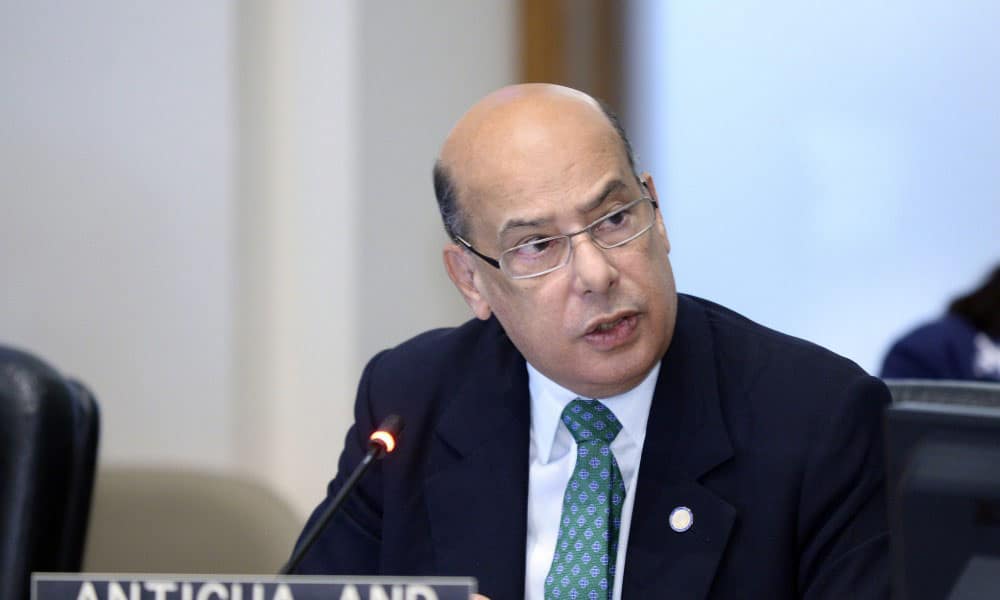
By Sir Ronald Sanders
(Author’s Note: This commentary is dedicated to Patrick Cozier of Barbados, whose probing occasioned its writing.)
In my article last week, “Hunger and War: The Oldest Crime the World Still Permits,” I argued that global hunger is not caused by a lack of food but by political decisions that produce war, destroy livelihoods, and block humanitarian access.
That view is echoed by the United Nations: a recent briefing on food insecurity, drawing on World Food Programme (WFP) analysis, noted that ending hunger by 2030 would cost about US $93 billion a year, while governments have spent US $21.9 trillion on their militaries over the last decade.
Those figures from the UN and WFP show that US $93 billion per year—less than one per cent of that military spending—would end global hunger. The contrast exposes the chasm between our professed values and our actual priorities.
If the world can afford trillions for weapons, it can afford a fraction of that to feed the hungry. But outrage alone fills no stomach.
We need action. That is why I am suggesting here a clear, affordable way to do so: a global humanitarian contribution of just US $0.75 for every barrel of oil produced, applied for five years. That task is not easy, but the arithmetic is simple.
Data based on the U.S. Energy Information Administration show that global petroleum and liquids supply in 2023 averaged about 101.8 million barrels per day—roughly 37 billion barrels a year.
A contribution of US $0.75 per barrel, if applied to all globally produced barrels, would raise about US $28 billion annually—around US $140 billion over five years—nearly US $50 billion more than the UN’s estimate of what is needed to eradicate hunger.
For every US $100 earned from selling a barrel of oil, just 75 cents would end hunger. Even at modest oil prices, such a levy amounts to well under one per cent of global oil receipts—far smaller than routine daily price swings. Yet for hundreds of millions of people, that 75 cents would mean survival.
The concentration of global oil production makes coordination feasible. Various international energy datasets show that a relatively small group of major producers—including the United States, Saudi Arabia, Russia, Canada, China, Iraq, Brazil, the United Arab Emirates, Iran and Kuwait—accounts for most of the world’s output.
From a geopolitical standpoint, the fact that so much production is centred in a small number of countries adds weight to the moral argument. Those who extract vast value from the earth have both the capacity and, arguably, the responsibility to contribute to humanity’s survival.
Oil and gas revenues have enriched producing states and their companies and helped fuel global development.
But the same fossil-fuel use has driven climate change and intensified droughts, floods and storms that destroy crops, displace people, and deepen food insecurity—especially in vulnerable regions such as the Sahel, the Horn of Africa, small island developing states, and parts of Central America and South Asia.
UN-backed assessments now consistently identify conflict and insecurity, economic shocks and climate-related extremes as the key converging drivers of acute food insecurity and malnutrition.
Critics will say the oil industry will never agree to a 75-cent contribution from every US $100 barrel.
That may be true if voluntary goodwill is the expectation. But governments can act collectively.
Both oil-producing and oil-consuming nations could adopt this solidarity measure at the point of extraction or import—much as France, Brazil and Norway did when they introduced a modest levy on airline tickets to fund UNITAID’s lifesaving programmes.
That mechanism has functioned successfully for nearly two decades and is now a template for new global solidarity levies.
Unlike military spending, which has risen for six consecutive years and reached a record US $2.72 trillion in 2024, according to the Stockholm International Peace Research Institute, this humanitarian contribution would be modest, transparent and morally compelling.
It would also allow the energy sector—often criticised for its environmental record and windfall profits—to participate meaningfully in one of the great humanitarian achievements of our century.
The reputational return for governments and companies would far outweigh the cost.
For energy-exporting nations, such a measure could be a diplomatic asset, demonstrating global leadership and compassion at a time when trust is in short supply.
For importing nations, it could be an act of solidarity toward a world fracturing under the strain of inequality.
And for multilateral institutions, it would show that cooperation can still cut through an era of fracture and mistrust.
This proposal recognises that hunger is not a failure of food production but of political will.
International reports show how conflict, climate extremes and economic shocks drive food crises—from Gaza, Sudan and Ukraine to the eastern Democratic Republic of the Congo, Haiti, and climate-vulnerable regions in the Caribbean, Central America, sub-Saharan Africa and the Pacific.
These crises persist not because the world lacks means, but because those with power choose inaction.
A contribution of US $0.75 per barrel—far less than the cost of a single cup of coffee—to ensure that no child goes to bed hungry is not charity. It is justice—long overdue, and well within reach.
(The author is the Ambassador of Antigua and Barbuda to the United States and the OAS, and Dean of the OAS Ambassadors accredited to the OAS. Responses and previous commentaries: www.sirronaldsanders.com)