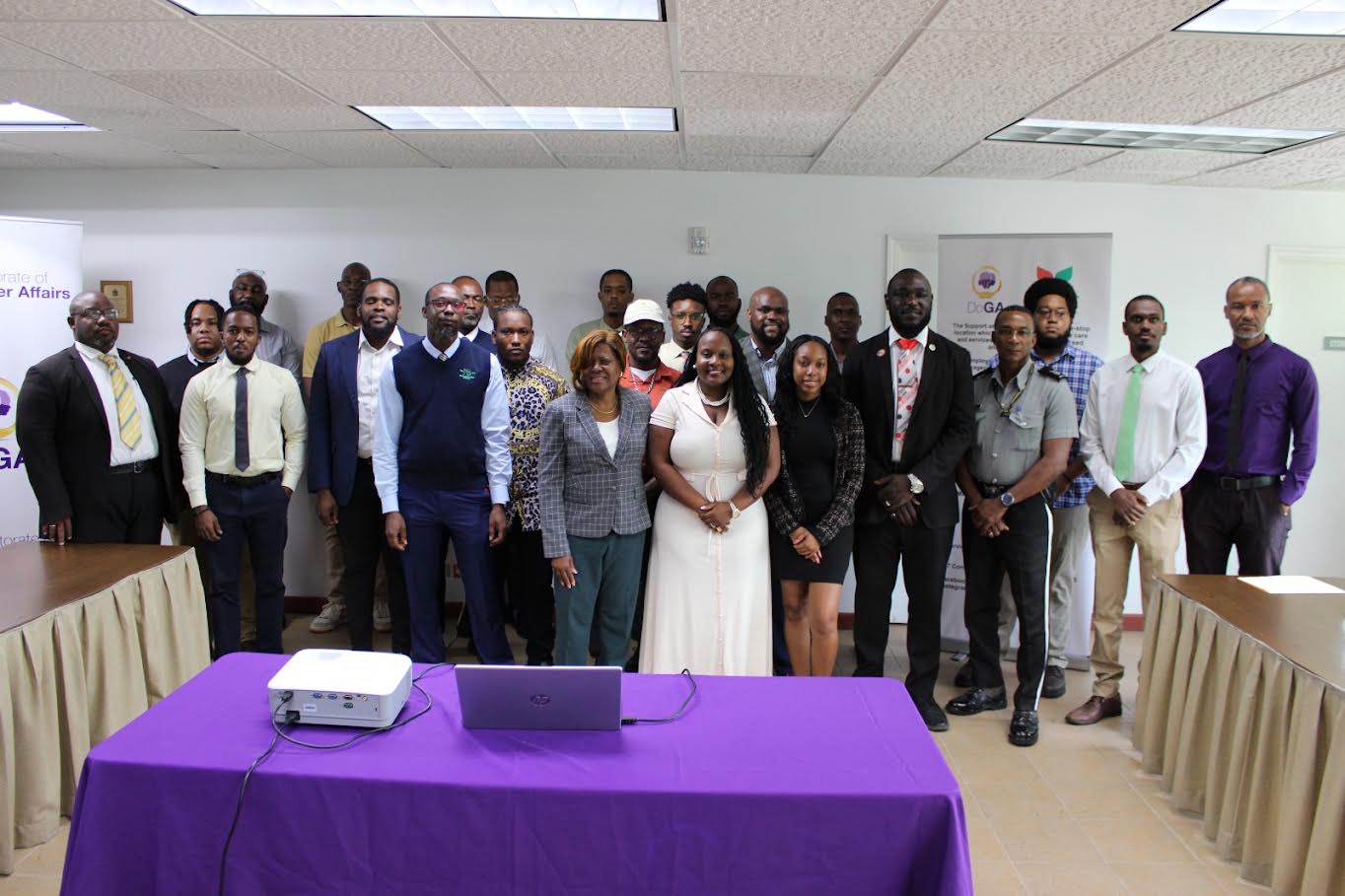
More than 20 men participated in the “Man in the Mirror Men’s Forum” on Wednesday, engaging in candid discussions about masculinity, mental wellness, violence, relationships, stigma, and other critical issues affecting men and boys in Antigua and Barbuda.
The forum, hosted by the Directorate of Gender Affairs, formed part of the Directorate’s Men’s Critical Issues Series under its Masculinity Portfolio and attracted participants from organisations across the country.
Programme Officer for Men’s and Mental Health, Rafiq Martin, described the session as “an honest, respectful and courageous conversation” about gender-based violence and masculinity.
“Today is not about blaming men or women. It is about understanding how gender-based violence affects all of us,” Martin said.
He noted that society’s ideas about masculinity influence men’s behaviour and relationships, adding that individuals must consider what they can do to create safer homes, healthier relationships and stronger communities.
Minister of State in the Ministry of Social and Urban Transformation, Kiz Johnson, highlighted the pressures men often carry in silence. She pointed to global data showing that men die by suicide at higher rates than women and are more likely to use lethal methods.
“Strength is not the absence of emotion. Crying does not make you weak. Asking for help does not make you less of a man,” Johnson told participants.
Johnson also called for greater recognition of men and boys who experience abuse, noting that their experiences are sometimes overlooked in conversations about gender-based violence.
Meanwhile, the Executive Director of the Directorate of Gender Affairs, Jamie Saunders, said it is important to create safe spaces where men and boys can speak openly about the issues affecting them, and explained that the discussions generated during the forum would extend beyond the event and could help inform future policies, advocacy and legislation.
“It will be used to shape policies, it will be used to advocate for legislation, to ensure that men and boys are included in the conversation and they understand gender equality,” Saunders said.
An interactive presentation, which examined masculinity and male socialisation, was facilitated by Keiron Murdoch, who stressed that both men and women must be involved in efforts to combat gender-based violence.
“Treating the issue of combating gender-based violence as a women’s issue just does not work because it’s not a women’s issue,” he said. “It is an all-of-society issue that affects women predominantly, but it affects men, it affects boys, it affects girls.”

Masculinity and Violence Forum Attracts Over 20 Men