Questions Grow – By Algernon Watts
Questions Grow Over Browne
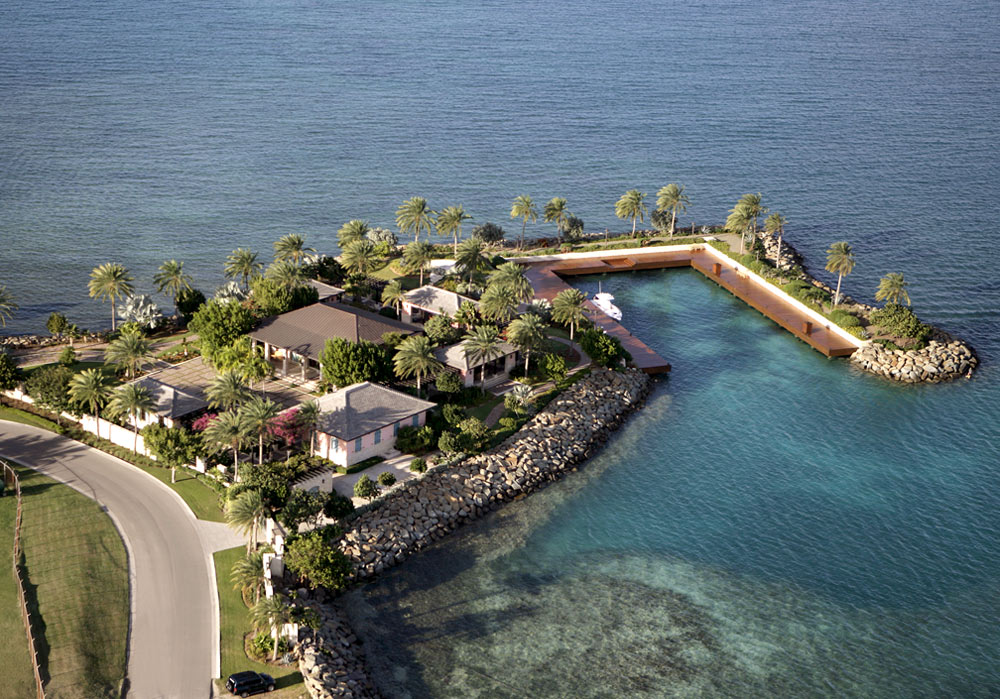
Prime Minister Gaston Browne says his family could eventually build luxury villas worth around US$4 million each on private property at Barnacle Point, where dredge spoil generated through public marine works is helping to transform the adjoining coastline, sharpening questions over the intersection of government resources, public development and private family interests.
The issue extends beyond the value of the proposed villas. The Government has invested in the dredging capacity responsible for major marine works, has separately identified Barnacle Point for high-end tourism development, and statutory agencies have approved the reclamation project beside property owned by the Prime Minister’s son.
Against that backdrop, Browne’s disclosure on Saturday that the family expects to create significant commercial value at the site places renewed focus on how the dredged material was allocated, what the state received in return, who participated in decisions affecting the site and whether any potential conflicts of interest were formally declared or managed.
Browne has rejected suggestions of preferential treatment and argues that the arrangement has instead saved taxpayers money, since the dredged material would otherwise have had to be transported elsewhere for disposal.
He said the family is contemplating approximately three luxury villas as part of the development, alongside an artificial reef, extensive landscaping and potentially a seafood restaurant extending over the water.
“I guarantee that my son can actually sell those at least maybe four million US apiece,” Browne said.
His son, Gaston Andron Browne III, has owned the adjoining private property for more than a decade, according to the Prime Minister, who portrayed the project as an example of using entrepreneurship, existing family assets and material that might otherwise have been discarded to create substantial value.
But the material helping to reshape the coastline did not originate as a private family resource.
Browne acknowledged that it came from dredging works and said the Government would have faced a multimillion-dollar bill to dispose of it elsewhere.
“The Government ordinarily would have had to have spent several more million dollars to take the dredge spoil” elsewhere, he said.
He stressed that his family was not uniquely favoured, identifying APUA and NAMCO among public entities that have received dredged material and saying other private landowners have also benefited.
That explanation makes the criteria governing those allocations particularly relevant. Who qualifies to receive dredge spoil generated through public projects, who decides where it goes, whether private recipients pay for the material or transportation, and whether agreements are executed setting out the public and private obligations.
The Barnacle Point development, known as Peace Beach, first attracted significant public attention in October 2025 when Browne announced plans to use dredged material to create additional usable land and beachfront.
At the time, Browne said the Development Control Authority and environmental authorities had approved the reuse of the dredge spoil for the project. He said the development would include an artificial reef intended to improve marine biodiversity and shoreline resilience.
Days later, questioning moved to Parliament.
Browne told lawmakers that although privately owned property sits behind the project, the newly reclaimed land itself belongs to the state.
“All reclaimed land is public land,” he said, while maintaining that the development had obtained all necessary environmental and statutory approvals.
He also rejected suggestions that the reclamation infringed rights associated with the neighbouring Yida development, arguing that Yida held no such marine rights and noting that other sections of the Barnacle Point coastline had historically been created through dredging.
That public-private boundary becomes increasingly important as the commercial ambitions for the site expand.
If the reclaimed land remains state property while multimillion-dollar villas and other commercial facilities are developed on private land immediately behind it, clarity will be needed over access, boundaries, infrastructure and the extent to which the publicly created beachfront enhances the use and value of the adjoining private property.
There is another dimension.
The dredging programme itself has involved Blue Ocean, a company in which the Government has steadily increased its investment.
Government initially acquired a 40 percent stake in Blue Ocean through the National Asset Management Company, NAMCO. More recently, Browne said the state was moving to approximately 75 percent ownership through a US$2.5 million investment in specialised marine equipment intended to strengthen the company’s ability to undertake dredging, reclamation and other coastal works.
By August this year, Cabinet was publicly describing Blue Ocean as a company in which the Government holds a majority shareholding, after the company completed dredging at Crabbes Harbour and prepared to move its equipment to St John’s Harbour.
Those projects are unquestionably public in purpose. The Crabbes works were designed to accommodate larger LNG and cement vessels, while the St John’s Harbour programme is intended to accommodate larger commercial and cruise vessels.
But the reuse of spoil generated by such public works on a coastline adjoining the Prime Minister’s son’s property creates a separate accountability question over how a by-product of publicly funded infrastructure is distributed when it can materially enhance private real estate.
The Barnacle Point issue now arises in an area where the Government itself has significant development ambitions.
Earlier this year, Browne announced that the Government was exploring a high-end mega-yacht marina at Barnacle Point, potentially requiring US$20 million to US$30 million in investment and supported by upscale restaurants and other facilities catering to wealthy visitors.
Those plans could make Barnacle Point considerably more commercially attractive if realised, adding another reason for transparency over the relationship between the state’s wider development strategy and private property interests in the immediate area.
The history of Barnacle Point itself stretches into the collapse of the Allen Stanford business empire.
Browne, meanwhile, has presented his family’s current development as straightforward value creation.
He said the family is using trucks, backhoes, excavators and bulldozers accumulated over decades to shape the site, describing much of that machinery as an existing investment and saying the main ongoing expenses involve operators and fuel.
Artificial reef structures have already been purchased and are being shipped to Antigua, according to Browne, who said they would create habitat for marine life including lobster and octopus.
Palm trees and other landscaping are also planned, along with the possible seafood restaurant and three high-end villas.
Browne has said the beach itself will remain available to the public.
His argument is essentially that all sides benefit. Government avoids spending millions disposing of material it does not need; dredge spoil is put to productive use; the public gains a new beach and improved coastline; and private property owners, including his family, can create economic value from their own adjoining land.
The unresolved issue is not whether private development beside public infrastructure is inherently improper. It is whether the same opportunity was available on transparent and equal terms to others, whether the public resource was independently allocated, and whether the decision-making process was sufficiently insulated from the political power of the family that stands to benefit.
With Browne now estimating that villas on his son’s property could fetch at least US$4 million each, those questions carry considerably more weight than when Peace Beach was first presented simply as a reclamation and environmental project.