Dear Editor,
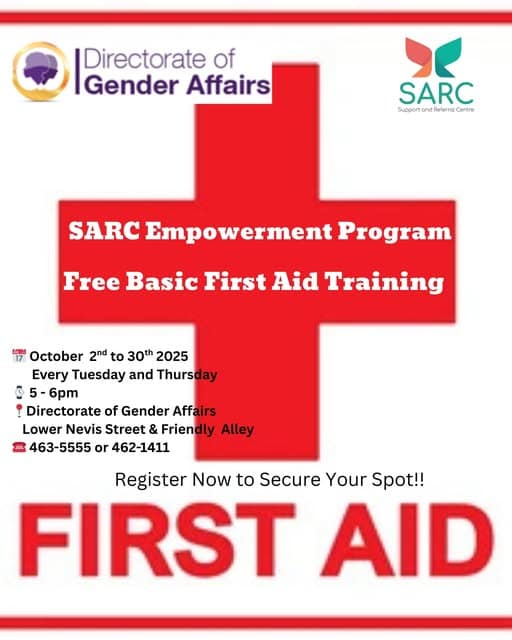
I read with interest the recent announcement from the Directorate of Gender Affairs offering free Basic First Aid Training under its SARC Empowerment Programme.
At first glance, such an initiative may appear noble, since providing life-saving skills to the public is indeed important. However, I find myself deeply concerned that the Directorate may be straying far outside its core mandate, particularly at a time when pressing issues under its purview are being left unaddressed.
The question must be asked: Is this really the role of Gender Affairs? Antigua and Barbuda has established institutions with proven capacity and responsibility for first aid, emergency response, and health education—namely the Antigua and Barbuda Red Cross, the Emergency Medical Services (EMS), the American University of Antigua (AUA), and the Ministry of Health.
These organizations possess the trained professionals, recognized certification processes, and operational mandate to provide such training. Should we not be directing public first aid initiatives through them, rather than creating parallel programmes that may confuse the public about standards, accreditation, and accountability?
Meanwhile, we cannot ignore the reality that cases of domestic violence, sexual assault, and other gender-based crimes are surging in our society. Families and communities are crying out for support services, survivor protection, effective policy responses, and stronger advocacy from the very Directorate tasked with leading on gender and social concerns.
Yet, instead of focusing its resources on strengthening protection systems, enhancing awareness, and ensuring justice for vulnerable groups, the Directorate is diverting its limited capacity into areas already well covered by other competent bodies.
This raises a more fundamental question: Has Gender Affairs fully embraced and fulfilled its role? When issues of social concern—from gender equity in employment, to protection of women and children, to response to domestic violence—continue to mount, should the Directorate not be concentrating its energies on advancing solutions in those areas? Offering first aid training, without clarity on certification or the qualifications of instructors, risks looking less like empowerment and more like mission drift.
I ask, therefore, whether our institutions are holding firmly to their responsibilities. Do EMS, the Red Cross, AUA, and the Ministry of Health face challenges in fulfilling their core mandates, such that Gender Affairs feels compelled to step in? Or is it the Directorate itself that has lost sight of its priorities, thereby weakening its credibility and leaving urgent gender issues unaddressed?
We all want a society that is safer and stronger. But that will only be achieved if each institution focuses on its true role, collaborates where appropriate, and avoids duplication of efforts that can dilute impact. The people of Antigua and Barbuda deserve no less.
Respectfully,
Craig Nelson