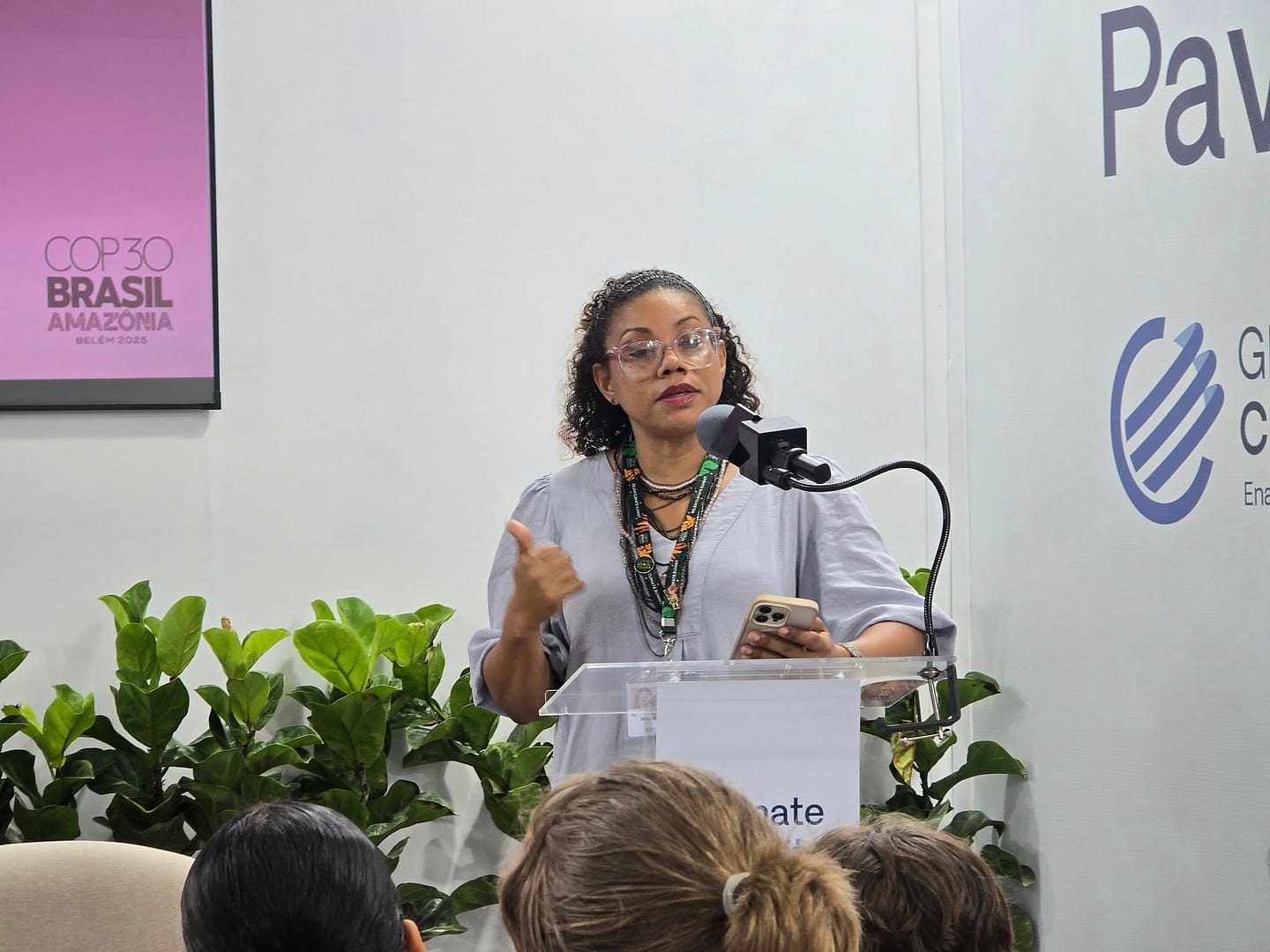
Antigua and Barbuda reaffirmed its leadership on climate justice and resilience during the High-Level Session on Climate Mobility in the Greater Caribbean, held at the Climate Mobility Pavilion at COP30 in Belém, Brazil.
Delivering the feature keynote address, Her Excellency Ruleta Camacho Thomas, Ambassador for Climate Change, called for stronger international collaboration, regional solidarity, and financing mechanisms to protect the rights, culture, and livelihoods of Caribbean people affected by climate impacts.
“Climate mobility is not a future threat — it is already happening in our region,” Ambassador Camacho Thomas stated. “After Hurricane Andrew, Dominicans came to Antigua seeking refuge. After Hurricane Irma, the entire population of Barbuda was evacuated to Antigua. These experiences show how vulnerable communities are already being forced to move, often losing their homes, their culture, and their sense of belonging.”
Ambassador Camacho Thomas emphasized that most people in Small Island Developing States (SIDS) want to remain in place because of deep cultural identity and ancestral connection to their land and sea. She called for increased investment in resilient infrastructure, housing technologies, and community-based adaptation to uphold the right to stay and to minimize displacement.
“For SIDS, climate mobility represents the human face of loss and damage,” she said. “Financing must therefore support not only recovery but the preservation of culture, livelihoods, and community integrity. Justice without finance is delay by another name.”
Highlighting Antigua and Barbuda’s leadership in global climate law, Ambassador Camacho Thomas referenced the Advisory Opinions of the International Court of Justice (ICJ) and the International Tribunal for the Law of the Sea (ITLOS), both of which reaffirm that States have a legal duty to prevent harm and that all peoples have the right to a healthy environment. She underscored that rising seas must never erase sovereignty or maritime rights, declaring:
“Loss of land must never mean loss of nationhood — nor loss of identity.”
The Ambassador also stressed the importance of regional cooperation, calling for a coordinated Caribbean approach to address mobility, social protection, and relocation planning. “No island can face this crisis alone,” she said. “Collaboration and solidarity are the foundation of our survival — we do not want cultural displacement; we want support to stay rooted, resilient, and proud of who we are.”
Antigua and Barbuda continues to champion the integration of climate mobility into National Adaptation Plans, NDCs, and Loss and Damage frameworks, ensuring that policies and financing reflect the realities of vulnerable island communities. The country remains a leading advocate for the use of the Multidimensional Vulnerability Index (MVI) to guide access to concessional finance and for direct funding channels that reach affected communities swiftly and effectively.