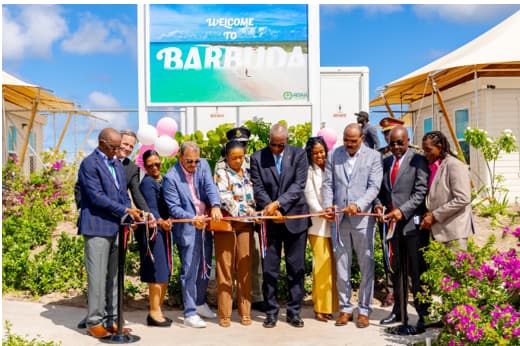
Barbuda has moved from chronic underdevelopment to becoming a net contributor to the national economy, Governor General Sir Rodney Williams declared Thursday as he delivered the Throne Speech at the opening of Parliament.
Sir Rodney said Barbuda had remained “a diamond in the rough for more than 60 years,” but that a series of major investments since 2014 had reversed its economic trajectory. He highlighted new hospitality projects—including PLH, Rosewood, Louie Hill and Nobu—as well as paved roadways, street lighting and new public infrastructure.
According to the Governor General, these developments “have begun to transform Barbuda into net-contributor status,” something he noted had never occurred since the creation of the Barbuda Council.
He also pointed to the island’s new international airport as a major part of that turnaround. Calling it “a new International Burton-Nibbs Airport,” Sir Rodney said it would be followed by “a new seaport capable of receiving container ships, new roads, new green energy plants, new freshwater-producing sources, and new housing stock in the aftermath of Hurricane Irma.”
A significant portion of the transformation, he said, came from long-delayed reforms to land tenure. Sir Rodney stated that by repealing the 2007 law and replacing it with “a just and fair law that would provide title to those who have dwelled on plots of land for generations,” the government ended an “injustice which previous administrations feared to change.”
He noted that the nation’s apex court had ruled definitively that “all land not privately owned in Antigua and Barbuda is the Crown’s,” a decision he said cleared the way for more secure investment and development.
Sir Rodney said the progress was the result of “an unrelenting vision of a better Barbuda,” crediting the persistence of national leadership in pursuing long-stalled reforms.
With additional projects on the horizon—including the planned seaport—Sir Rodney said the transformation already underway is positioning Barbuda for sustained economic contribution for the first time in its modern history.