False Alarm – By Sharon N Simon
False Alarm Exposes John
At approximately 11:20 am on Friday, all the workers in our four-storey building on Redcliffe hastily evacuated after fire alarms sounded. What followed was a 30-minute observation in urban emergency response that raised more questions than were answered.
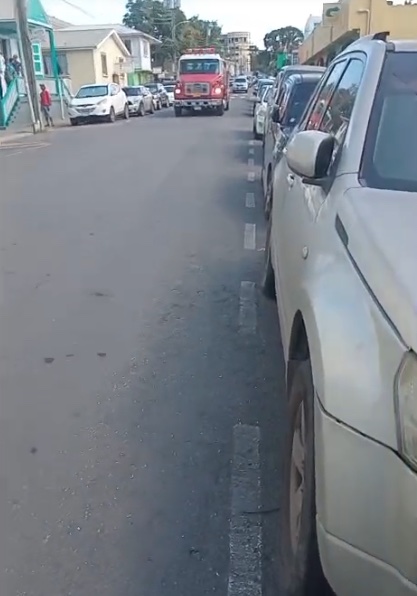
From the sidewalk, workers and other bystanders watched Freightliner G 337—a Ferrara pumper truck—navigate impossibly congested streets. The red apparatus, equipped with a Hale 1250 GPM pump capable of moving over 1,000 gallons per minute, sat trapped in gridlock despite blaring sirens. Cars packed both curbsides. Traffic crawled. The fire truck’s emergency lights reflected off stationary vehicles stretching beyond view.
Recorded video footage shows the stark reality: a single emergency vehicle blocking the narrow roadway, creating a bottleneck that paralyzed downtown traffic. SUVs, sedans, and commercial vehicles squeezed together, drivers uncertain where to go. A police officer on a motorcycle worked to manage the scene while firefighters, not fully geared, entered our building.
The culprit? Possible construction dust from tiling work on the third floor had triggered photoelectric smoke detectors. These sensors scatter light beams when particles enter—whether smoke or silica dust – it makes no difference to the technology. Evacuees reported a “burning scent,” likely dust contacting electrical components, which added to the urgency to evacuate.
The pumper carried no aerial ladder, which was of concern to several workers in our four-storey building. Fire service protocol explains this: pumpers respond first to assess situations. If crews confirm fire requiring high-altitude access, they call the ladder truck—a 40-foot apparatus with 75 to 100-foot hydraulic reach.
This strategy prevents massive, difficult-to-maneuver ladder trucks from gridlocking in traffic for false alarms. Friday’s congestion validated this approach. A larger vehicle would have found it impossible to navigate through streets designed decades before the volumes modern traffic.
Downtown St. John’s features colonial-era street grids that were never engineered for simultaneous emergency response and peak-hour traffic. Curbside parking, economically vital for businesses, restricts maneuvering space during emergencies. Should designated emergency corridors be established? Could parking restrictions near critical buildings improve response times?
Firefighters wearing minimal protective gear entered, suggesting dispatch had communicated “possible false alarm”. How did this risk assessment occur? What if the dust had masked actual smoke? The balance between efficient response and crew safety deserves examination.
Despite sirens, civilian vehicles struggled to clear paths. No alternative routing appeared activated. No traffic signal preemption prioritized the emergency vehicle. Do St. John’s traffic management systems include emergency override capabilities? Should they?
Our smoke detection system performed exactly as designed—protecting lives by alerting potential danger. Yet construction dust created a predictable false alarm. Should building codes require contractors to disable or cover detectors during renovation with fire service notification? What oversight ensures systems are restored immediately after work?
Video footage captures multi-storey offices, ground-floor shops, and government buildings in tight proximity—economic vitality creating density that complicates emergency access. As Antigua and Barbuda develops, how will infrastructure adapt? Can historic preservation coexist with modern emergency response requirements?
Friday’s incident wasn’t merely an inconvenience. Emergency resources were deployed. Traffic was disrupted for at least 30 minutes. Commerce was interrupted across a few blocks. Police were diverted from other duties. Had an actual emergency occurred elsewhere simultaneously, response capacity would have been compromised.
Yet false alarms also validate systems. Occupants practiced evacuation. Detection equipment proved functional. Emergency coordination was tested.
Building management now implements enhanced dust control protocols. Contractors will use containment barriers and schedule heavy work during low-occupancy hours. These practical measures prevent future false deployments.
But broader questions remain unanswered. Friday afternoon provided a real-time case study in urban emergency response challenges facing Caribbean capitals—aging infrastructure meeting modern demands, economic growth pressuring public safety systems, and communities adapting to realities their streets weren’t designed to handle.
The pumper truck eventually cleared our building, confirmed no fire, and departed. Traffic resumed. Business continued. But the video evidence and lingering questions deserve attention from urban planners, emergency services, and municipal authorities.
Sometimes the most valuable lessons come not from disasters, but from dust.